


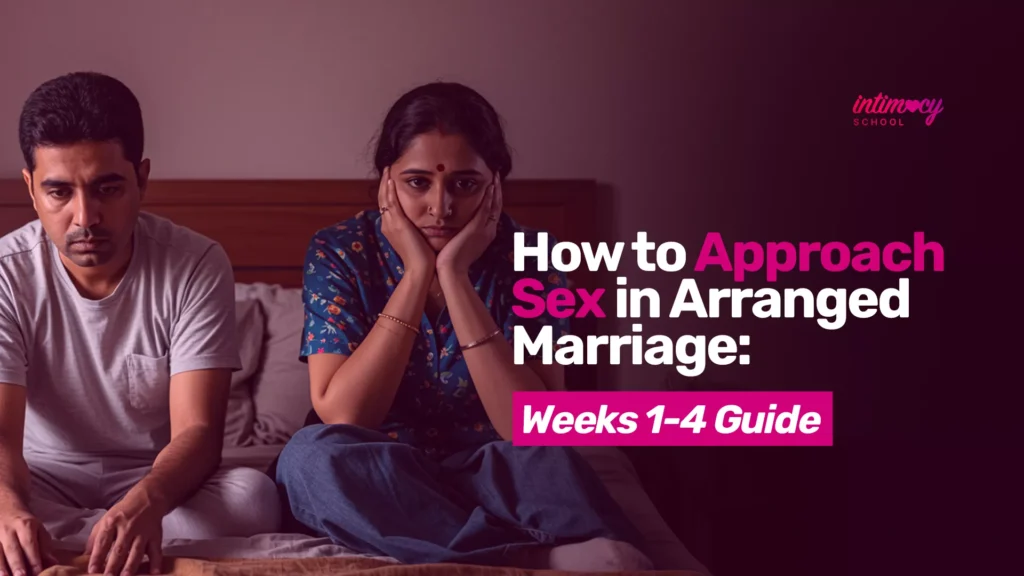
Starting sex in an arranged marriage feels impossible when you barely know each other. Here’s exactly how to approach intimacy in the first month — week by week, building comfort naturally.
Approach sex in arranged marriage through gradual weekly progression: Week 1 focuses on emotional comfort through conversation and non-sexual physical touch like holding hands, Week 2 introduces kissing and light touch without pressure for intercourse, Week 3 builds to extended physical intimacy and possible first penetration only when both genuinely feel ready, and Week 4 establishes early intimate patterns based on what worked in previous weeks. Most successful arranged marriage couples report this gradual month-long approach creates significantly better long-term intimacy than rushing physical connection in the first days. The key is prioritizing genuine comfort over timeline expectations.
Introduction
You married someone you barely know. Now you’re expected to be physically intimate with this near-stranger. How do you even start? Do you just… do it? Wait for them to initiate? Talk about it first? Jump in and hope for the best?
Most arranged marriage couples receive zero guidance on how to actually approach sex when you haven’t built physical familiarity gradually through dating. You’re supposed to figure it out yourselves while managing overwhelming life changes, cultural pressure, and potentially living with a joint family.
Here’s the truth: couples who rush into sex within days of arranged marriage often struggle with intimacy for months or years afterward. Couples who build comfort gradually over the first month typically develop strong intimate connections that last decades.
This complete guide gives you a realistic week-by-week plan for approaching sex in an arranged marriage. Not a rigid script, but a framework showing how to build physical intimacy naturally when starting from zero familiarity.
Why the arranged marriage sex approach needs to be different
Understanding the arranged marriage intimacy challenge
Love marriage couples enter marriage with months or years of physical familiarity. They’ve kissed hundreds of times. They’ve been physically close. They know each other’s touch, preferences, and comfort zones. Marriage doesn’t introduce physical intimacy – it continues what already exists.
Arranged marriage couples start from complete unfamiliarity. You might not have held hands before marriage. You haven’t kissed. You’ve barely touched. Every stage of physical intimacy is simultaneously new: first kiss, first intimate touch, first nudity, first penetration. This compression of intimacy stages that normally take months into a few days or weeks creates enormous pressure.
The cultural pressure that makes this harder:
An arranged marriage comes with crushing expectations about immediate consummation. Suhagraat pressure. Family jokes about “honeymoon baby.” Assumptions that sex should happen on the wedding night despite zero prior physical familiarity.
This pressure directly conflicts with what actually creates good intimate relationships: gradual comfort building, open communication, and respecting both partners’ readiness. Following cultural timelines usually creates worse intimacy than following your actual comfort.
Week 1: Building emotional comfort and basic physical familiarity
Week 1 goal: Get comfortable sharing space and conversation
Do not attempt sex during Week 1. Even if you think you’re ready, even if family pressure is intense, even if your partner seems interested. Week 1 is for building the foundation that makes all future intimacy better.
Daily conversation priorities:
Spend minimum 30-60 minutes daily in genuine conversation. Not small talk about the wedding or surface topics – actual conversations about values, fears, childhood experiences, what you want from marriage, and how you’re both feeling about this massive life change.
Ask open-ended questions: “What are you most nervous about in our marriage?” or “What does a good day look like for you?” or “How do you handle stress?” These conversations build emotional familiarity that makes physical touch feel less foreign.
Non-sexual physical touch to practice:
Hold hands while talking or watching something together. This is your baseline — if holding hands feels awkward, sexual touch will be impossible. Sit close enough that your bodies touch casually — shoulders, legs, arms. Physical proximity without agenda builds comfort.
Hug daily — brief hugs when parting and reuniting. If hugging feels stiff or uncomfortable, slow down. You need comfort with clothed embracing before moving to anything more intimate.
What sex approach in arranged marriage Week 1 should NOT include:
No attempting intercourse. No nudity. No touching intimate areas. Not because these are wrong, but because they’re multiple stages ahead of where comfort actually is. Jumping stages creates trauma that takes months to undo.
Week 2: Introducing kissing and intimate touch
Week 2 goal: Build comfort with kissing and light physical exploration
By Week 2, you should feel reasonably comfortable talking together, holding hands, and sitting close. If these still feel weird, stay in Week 1 longer. Don’t progress on calendar timeline – progress based on actual comfort.
How to approach first kisses in arranged marriage:
Start with brief lip kisses – 2-3 seconds, closed mouth, gentle. Don’t jump immediately to passionate kissing if you’ve never kissed before. Brief kisses repeated several times daily build comfort faster than one long, uncomfortable kiss.
Gradually extend kiss length and add variety as comfort grows. Open mouth, gentle tongue, different positions — these progress naturally over days of repeated comfortable brief kisses.
Introducing light intimate touch:
Touch non-sexual but sensitive areas: neck, lower back, inner arms, face. These touches aren’t explicitly sexual but create physical awareness and arousal without the pressure of touching obviously intimate areas.
Progress to touching over clothing on more intimate areas – breasts, hips, thighs – only when lighter touches feel completely comfortable. Touching over clothing provides a safety buffer while introducing sexual awareness.
Communication during Week 2 sex approach in arranged marriage:
Ask constantly what feels comfortable: “Is this okay?” “Does this feel good?” “Should I stop?” Never assume consent or comfort. Checking in verbally shows respect and creates safety that paradoxically makes physical intimacy progress faster.
What to skip in Week 2:
Still no nudity. No touching genitals directly, even over clothing. No attempting intercourse. Week 2 is about building comfort with kissing and non-genital intimate touch. These stages matter – skipping them usually backfires.
Week 3: Extended foreplay and possible first penetration
Week 3 goal: Build genuine arousal and consider first intercourse if both ready
Week 3 is when physical intimacy either progresses to intercourse or continues building comfort without it. Both outcomes are successful if based on genuine readiness rather than timeline pressure.
How to know if you’re ready for sex in arranged marriage:
You’re ready when: conversation flows naturally and you feel comfortable together, kissing feels genuinely pleasurable not just tolerable, touching intimate areas over and under clothing feels exciting not just awkward, you’re both expressing desire verbally (“I want to be close to you”), and crucially — both of you explicitly want to try intercourse, not just one person willing to accommodate the other.
You’re NOT ready if: conversation still feels forced or uncomfortable, physical touch feels like performing rather than genuine pleasure, one person is clearly nervous or reluctant, you haven’t discussed attempting intercourse and one person just assumes it will happen, or either person feels pressured by timeline rather than genuine desire.
If you’re ready for first sex in arranged marriage Week 3:
Dedicate 45-60 minutes with guaranteed privacy. This isn’t something to squeeze into 20 minutes before family returns. Extended time removes pressure and allows stopping if discomfort arises.
Start with extended foreplay — minimum 20-30 minutes of kissing, touching, and building genuine arousal before attempting any penetration. Her body needs time to prepare physically (lubrication, vaginal expansion) regardless of mental willingness.
Use lubricant even if natural lubrication seems adequate. First-time penetration in arranged marriage comes with nervousness that often reduces natural lubrication despite arousal.
Woman-on-top position for first intercourse gives her complete control over depth and speed. This control dramatically reduces pain and anxiety because she adjusts based on her body’s response rather than his pace.
If you’re not ready for sex in arranged marriage Week 3:
Continue building physical comfort through extended make-out sessions, touching intimate areas, possibly oral intimacy if both are comfortable. Non-penetrative sexual activities build arousal and comfort that make eventual intercourse significantly better.
Discuss openly that you’re not ready yet: “I want us to keep building our comfort before we try intercourse. How are you feeling about that?” Transparency prevents mismatched expectations and resentment.
Week 4: Establishing early intimate patterns
Week 4 goal: Develop consistent, comfortable intimate connection
By Week 4, you should have some established intimate routine — whether that includes intercourse or remains at non-penetrative intimacy. What matters is that whatever you’re doing feels genuinely comfortable for both people, not performed.
If you’ve had intercourse by Week 4:
Don’t make it a daily obligation just because it’s happened once. Quality beats frequency always. 2-3 times per week with genuine mutual desire creates better intimacy than daily obligatory sex.
Continue prioritizing extended foreplay every time. Early intimate patterns become lifelong habits. Couples who maintain 15-20 minute foreplay routines from the beginning maintain them for decades.
Communicate after each intimate experience: “How did that feel for you?” or “What would make it even better?” Early communication habits establish that talking about sex is normal in your relationship.
If you haven’t had intercourse by Week 4:
This is completely normal and arguably healthier than forced early intercourse. Many successfully married couples took 6-8 weeks or longer to reach intercourse, and they report this gradual approach created excellent long-term intimacy.
Continue progressing physical comfort at whatever pace feels right. Keep communicating about what feels good, what you’re curious about trying, and what still feels too much too fast.
Consider whether any specific fear or obstacle is preventing intercourse. If it’s purely comfort-building, continue gradually. If there’s anxiety, pain concerns, or other specific issues, address those directly.
Building the intimate foundation for years ahead:
The patterns you establish in Week 4 often predict your intimate life for years. Couples who communicate openly in Week 4 continue communicating. Couples who prioritize mutual pleasure in Week 4 maintain that priority. Couples who rush through preparation in Week 4 often struggle with that pattern indefinitely.
How to handle sex approach in arranged marriage with joint family
The privacy problem in arranged marriage sex approach
Many arranged marriage couples live with joint family, making the week-by-week approach infinitely harder. Building intimate comfort requires guaranteed privacy, which joint families rarely provide naturally.
Creating privacy in joint family for arranged marriage sex:
Establish bedroom boundaries immediately: knock before entering, locked door during certain hours is normal and expected. Communicate this to family directly but diplomatically: “We need some private couple time in the evenings.”
Plan outings together — long walks, dinners, drives — where you can talk and build physical comfort away from family observation. Holding hands during a walk is impossible in a crowded family living room.
Consider brief stays elsewhere if possible: hotels for a night, visiting friends with more privacy, anywhere that gives you unobserved time to build physical comfort. Even 24 hours of complete privacy accelerates comfort-building significantly.
For comprehensive privacy strategies, our complete guide on privacy in joint family covers specific tactics for creating intimate space in shared living situations.
Common mistakes approaching sex in arranged marriage first month
Mistake 1: Attempting intercourse on wedding night
Suhagraat pressure makes couples attempt sex when exhausted, overwhelmed, and barely familiar with each other. This often creates trauma — pain, anxiety, bad first memories — that takes months to overcome. Starting sex approach in arranged marriage after resting from wedding exhaustion creates much better experiences.
Mistake 2: One person forcing timeline
If one partner is ready faster than the other, pressuring or manipulating toward sex creates resentment and fear that poisons intimacy for years. Mismatched pace is normal — the faster partner must accept the slower partner’s timeline without pressure or guilt-tripping.
Mistake 3: Never discussing sex directly
Hoping sex will “just happen naturally” without conversation leaves both people confused about expectations, boundaries, and desires. Direct conversation — “I think I’m ready to try getting more physical. How are you feeling?” — removes guesswork and creates clarity.
Mistake 4: Following other couples’ timelines
Your friend might have had sex on their wedding night. Your colleague might have waited three months. Neither timeline matters for your relationship. Your pace is the only pace that matters. Comparison creates pressure that undermines comfort.
Mistake 5: Skipping non-sexual physical comfort
Couples who jump from minimal touch to attempting intercourse skip crucial comfort-building stages. Holding hands might seem unnecessary, but it’s foundational. Bodies need gradual familiarity stages — rushing through them usually creates problems later.
When to seek help with sex approach in arranged marriage
Normal challenges vs. problems requiring help
Normal challenges in arranged marriage sex approach include: initial awkwardness, nervousness, some performance anxiety, taking 4-8 weeks to feel genuinely comfortable, and mismatched pace between partners. These resolve with time and patience.
Problems requiring professional help include: complete inability to attempt intercourse after 8+ weeks despite genuine attempts, severe pain that doesn’t improve with proper technique, debilitating anxiety preventing any physical intimacy, or one partner consistently forcing or pressuring despite the other’s clear discomfort.
When to consult professionals:
If physical pain persists despite arousal, lubrication, and gentle technique, see a gynecologist. Conditions like vaginismus are highly treatable but require medical guidance.
If anxiety or trauma from past experiences prevents any intimate progress despite desire to connect, consult a counselor specializing in relationship and intimacy issues.
If fundamental incompatibility — one partner wanting no intimacy ever, the other wanting it urgently — creates relationship crisis, couples counseling helps navigate this challenge that won’t resolve through solo efforts.
FAQs
How to start sex in arranged marriage when we’re both completely inexperienced?
Shared inexperience is actually an advantage if approached collaboratively. Frame it as learning together: “Neither of us knows what we’re doing, and that’s okay. We’ll figure it out together.” Start with Week 1 foundation and progress gradually. Read educational content together, communicate constantly about what feels good, and permit ongoing awkwardness. Many couples with best intimate lives started with zero experience but strong communication.
What if my partner wants to rush sex approach faster than I’m comfortable with?
Communicate your boundary clearly: “I need more time to feel comfortable. Can we slow down?” If your partner responds with understanding, that’s healthy. If they respond with pressure, sulking, anger, or manipulation, that’s a serious red flag about respect. Your comfort timeline is non-negotiable. Healthy partners respect this without needing to be convinced.
Is it normal to take longer than one month to have sex in arranged marriage?
Completely normal. Some couples need 2-3 months to build adequate comfort for intercourse, especially if living in joint family with privacy challenges or if one or both partners have significant anxiety. Timeline doesn’t matter — establishing genuine comfort and positive intimate connection matters. Rushing to meet arbitrary timelines damages intimacy.
How to approach sex in arranged marriage if she seems completely uninterested?
Apparent disinterest often masks fear, anxiety, lack of arousal, or cultural conditioning that female desire is shameful. Have a gentle conversation: “I notice you seem hesitant about physical intimacy. Can you help me understand what you’re feeling?” Her honest answer provides more useful information than guessing. Address her actual concerns rather than assuming disinterest.
What if we tried sex too early and it went badly?
Bad early experiences are recoverable. Acknowledge what happened: “That was uncomfortable for both of us. Let’s slow down and build more comfort first.” Return to earlier stages — Week 1 or 2 activities — and rebuild foundation properly. Many couples who had terrible first attempts developed excellent intimacy by resetting and progressing more gradually.
How do we know when we’re actually ready vs. just feeling pressure?
Genuine readiness includes: both people actively expressing desire (“I want to try” not “I guess we can”), physical comfort already established at lighter stages, conversation about attempting sex that both people engaged in willingly, and excitement rather than dread. Pressure feels like: doing it because “we should,” one person willing to accommodate rather than genuinely wanting, anxiety dominating excitement, or avoiding conversation about it entirely.
Conclusion
Approaching sex in arranged marriage requires patience that cultural expectations don’t encourage. You’re told to consummate immediately. Reality is that the best intimate relationships in arranged marriage are built gradually over weeks and months, not forced into the first days.
Follow your actual comfort, not cultural timelines. Progress through stages that might feel unnecessarily slow but create the foundation for decades of good intimacy. Communicate constantly even when it feels awkward.
The couples with amazing intimate lives ten years into arranged marriage rarely had perfect first months. They had gradual comfort-building, honest communication, and mutual respect for each other’s pace. You can build this too.
Start today with Week 1 foundations. Have one genuine conversation. Hold hands. Build the comfort that makes everything else possible.